Cell Cycle Practice Quiz Biology Diagrams Key events that occur during the G1 phase include: 1. Cell Growth: The cell increases in size as it accumulates the necessary resources and organelles to support future cell division. During this phase, the cell obtains sufficient nutrients, energy, and building blocks for DNA replication and overall cellular functions. 2. Protein Synthesis
The cell cycle consists of a timed sequence of events that occur during interphase and mitosis (M). Interphase is made up of the G 1 (G = gap) phase, the S (synthesis) phase, and the G 2 phase (Fig. 15-2).Both G phases contain checkpoints that govern whether the cell moves into DNA replication (G 1 checkpoint) or into mitosis (G 2 checkpoint).. The G 1 and G 2 phases involve the synthesis of The G1 phase, or Gap 1 phase, is the first stage of interphase in the cell cycle. It is a period of cell growth, metabolic activity, and preparation for DNA synthesis. they perform their regular functions. This phase can be temporary or permanent. Temporary G0 allows cells to re-enter the cycle under appropriate conditions, while permanent

Wikipedia Biology Diagrams
Mitosis in an animal cell (phases ordered counter-clockwise), with G 1 labeled at left.. The G 1 phase, gap 1 phase, or growth 1 phase, is the first of four phases of the cell cycle that takes place in eukaryotic cell division. In this part of interphase, the cell synthesizes mRNA and proteins in preparation for subsequent steps leading to mitosis. G 1 phase ends when the cell moves into the S
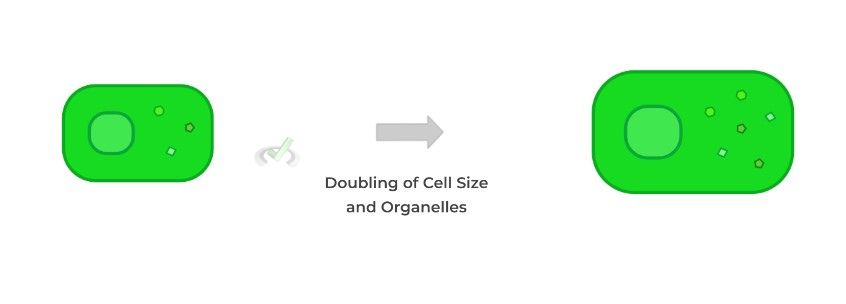
Main Functions of G1 Phase. The G1 phase is often referred to as the growth phase, because this is the time in which a cell grows. During this phase, the cell synthesizes various enzymes and nutrients that are needed later on for DNA replication and cell division.The duration of the G1 phase is variable and it often depends on the nutrients that are available to a cell. The G1 phase is divided into two intervals based on a cell's dependence on mitogen signals for sustained cell cycle progression (Fig. 2A).In early G1, proliferation-competent cells require mitogenic signals to keep progressing through the cell cycle. Once a cell progresses past the restriction point (R) and into late G1, it is no longer dependent on mitogens and is intrinsically committed to

Cell Cycle G1 Phase - an overview Biology Diagrams
M phase. Mitosis followed by cytokinesis (cell separation) Formation of two identical daughter cells; G0 phase. While some cells are constantly dividing, others are quiescent. These cells exit G1 and enter a resting state called G0. In G0, a cell is performing its function without actively preparing to divide.